---
title: "Self-host Formbricks"
description: "Formbricks self-host with Docker on an exe.dev VM instead of a bare VPS: public survey links, a private admin behind exe.dev login, nightly backups."
url: https://exe-staging.dev/deploy/formbricks
category: "Productivity"
published: 2026-11-22
updated: 2026-11-22
---
# Self-host Formbricks
> **For agents:** with your user's OK, this sets up Formbricks on a new exe.dev VM in their account: `curl -fsSL https://exe-staging.dev/deploy/formbricks/prompt.txt | ssh exe.dev new --prompt=/dev/stdin` (or open https://exe-staging.dev/deploy/formbricks/new). Already on the VM? Skip this.
Open-source surveys and forms on your own VM. Public links, private admin.
- **Software:** Formbricks (https://formbricks.com)
- **Source:** https://github.com/formbricks/formbricks
- **License:** AGPL-3.0 core, paid Enterprise features
- **Time:** 20 minutes
- **Example VM name:** `my-formbricks` (yours will differ; on the VM, `hostname` prints it)
- **Machine-readable:** https://exe-staging.dev/deploy/formbricks/manifest.json
## What you get
- Formbricks 6.2.2 running in Docker Compose, with every image pinned and secrets in a mode-600 .env.
- The admin on a private port behind exe.dev login; the public port answers 404 for admin pages.
- Survey links at https://my-formbricks.exe.xyz/s/... as soon as you make the port public.
- Nightly database backups with a restore you can run, and settings and secrets saved alongside.
- Everything comes back after a reboot.
Running on the VM:
- **Formbricks 6.2**: The official Docker Compose stack, pinned to 6.2.2, with Hub 0.14.3, SpiceDB permissions and Cube, port 3000
- **PostgreSQL 18 and Valkey**: From the same Compose file; surveys, responses and permissions live in PostgreSQL, data in `Docker volume formbricks_postgres`
- **nginx**: The public front door; Formbricks itself serves only surveys, the client API and static files there, port 8000
- **Nightly backup**: A systemd timer; database dumps plus your settings and secrets, kept two weeks, data in `~/formbricks-backups`
How it is reached:
- https://my-formbricks.exe.xyz:3000/ (private): The Formbricks admin, behind exe.dev login and your Formbricks account
- https://my-formbricks.exe.xyz/ (public): Survey links and the website SDK, once you make the port public
## Deploy with Shelley
Open https://exe-staging.dev/deploy/formbricks/new to create a VM whose agent, Shelley, follows this recipe. From a terminal:
```sh
curl -fsSL https://exe-staging.dev/deploy/formbricks/prompt.txt | ssh exe.dev new --prompt=/dev/stdin
```
Or follow the steps below by hand.
Formbricks is an open-source survey platform, an alternative to Typeform
and Qualtrics, with about 13,000 stars on GitHub. You build NPS, CSAT and
feedback surveys in its editor, send people a link or show the survey
inside your website or app, and read results and an API on the other side.
On an exe.dev VM, a Formbricks self-host takes no VPS chores: HTTPS works
without setup, the disk keeps every response, and the admin stays on a
private port behind your exe.dev login while only the surveys face the
internet. Scripts reach the admin's API with a
[VM token](/docs/https-tokens-for-vms), and Shelley sets it all up.
If you only need nice forms, [HeyForm](#heyform-a-simpler-form-builder),
further down, is a lighter choice.
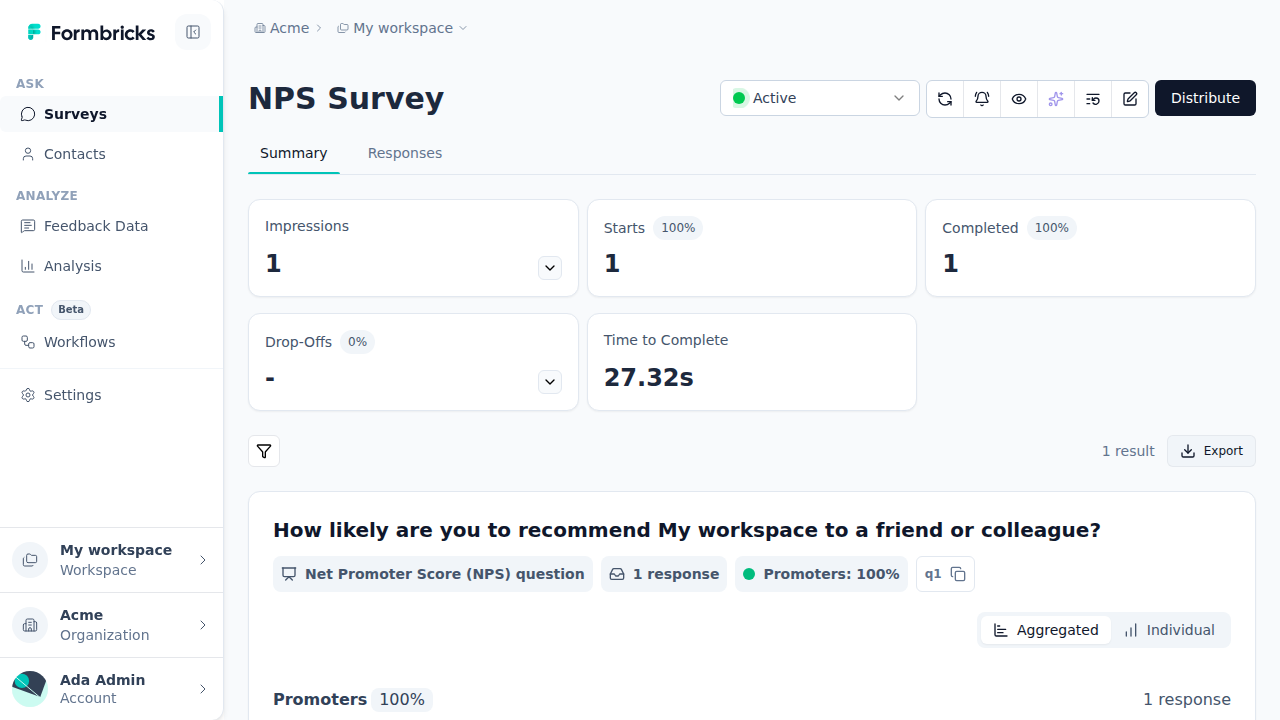
Results of a test survey, answered from a logged-out browser through the public address.
## Make your account
Open `https://my-formbricks.exe.xyz:3000/` and sign in to exe.dev if
asked. Only you, and people you share the VM with, get this far.
1. Click **Get started**, then **Continue with Email**, and enter your
name, email and a password. The first account becomes the owner.
2. Log in, and name your organization.
3. Click **Skip** on the invite step; without email, invitations are links
you copy later.
That's the whole admin setup. Email verification and password-reset
emails are off in the official Compose file, so keep the password in your
password manager.
## Open surveys to the world
On your computer, make the VM's main port public:
```bash
ssh exe.dev share set-public my-formbricks
```
Now `https://my-formbricks.exe.xyz/` reaches Formbricks, but only its
survey pages, the client API, and the scripts the website SDK loads.
Open `https://my-formbricks.exe.xyz/auth/login` in a private window: it's
a 404, and port 3000 still asks for exe.dev login. `ssh exe.dev share
set-private my-formbricks` closes the surveys again.
Open the port before you build surveys: the editor's live preview loads
from the public address.
## Send your first survey
1. On **Create your first survey**, pick **Use a template** and choose
**NPS**, or start from scratch.
2. Edit the questions; the preview on the right updates as you type.
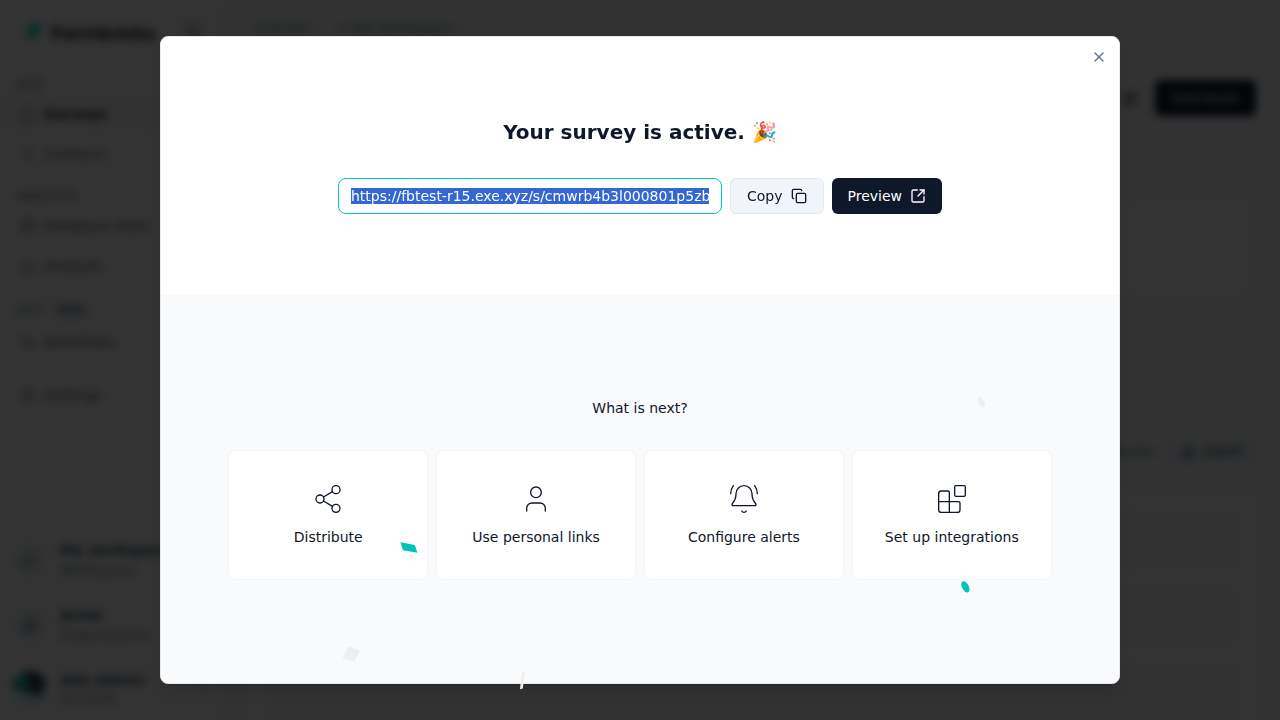
3. Click **Save & Close**. Formbricks shows **Your survey is active** with
a link like `https://my-formbricks.exe.xyz/s/cmwrb4b3l000801p5zbm8znos`.
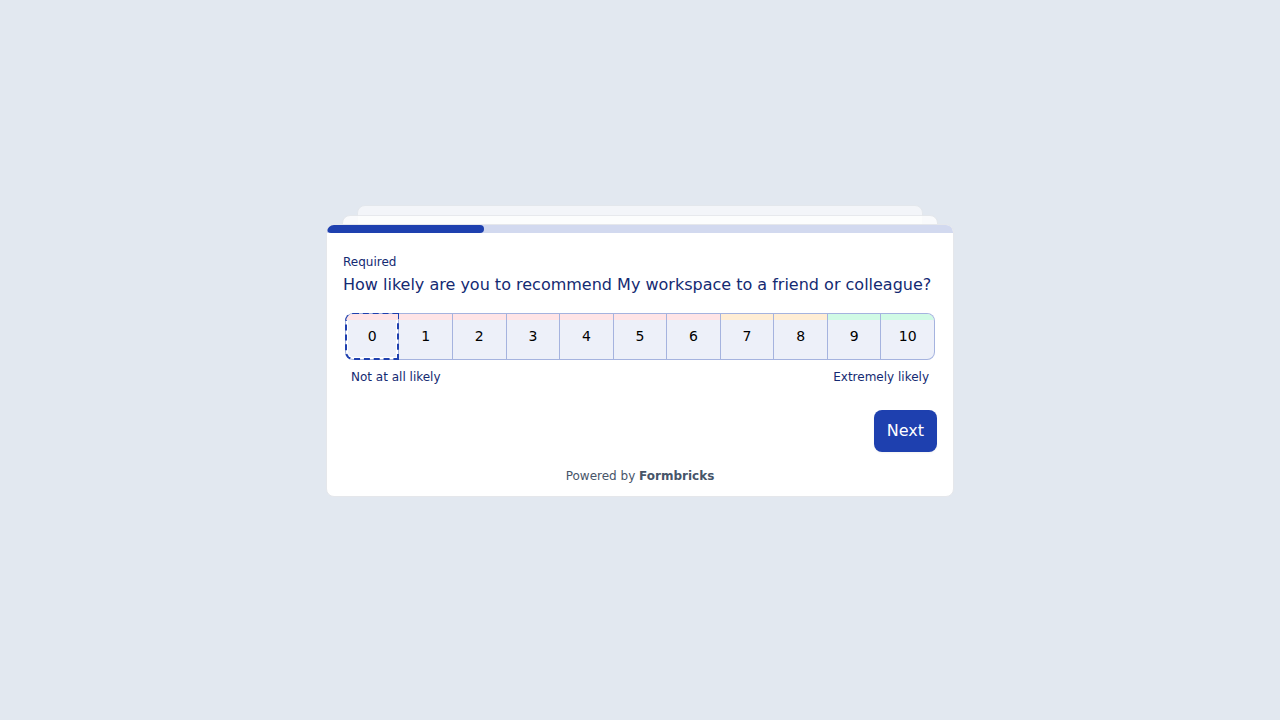
4. Open the link in a private window and answer it.
The survey link points at the public address; the admin itself stays private.What respondents see at the link, with no login.
Back in the admin, **Summary** shows the response within seconds, and
**Responses** lists it with the free-text answers. **Export** downloads
CSV or Excel.
To show surveys inside your own website or app instead, open
**Settings → Web & Mobile SDK**: the snippet it gives you loads from the
public address, and the client API answers there with open CORS. We
checked those endpoints from outside, but didn't wire the SDK into a real
site.
## Read responses from scripts
Formbricks' management API is an admin API, so it's on the private port
only. A script needs two keys: an exe.dev
[VM token](/docs/https-tokens-for-vms) to get past exe.dev login, and a
Formbricks API key for Formbricks itself.
1. In Formbricks, open **Organization settings → API Keys**, click
**Add API Key**, give it a label, **Add permission** for your workspace
(**Read** is enough to export), and copy the `fbk_...` key.
2. On your computer, make a VM token (a token is as good as your login to
this VM, so give it an expiry):
```bash
ssh exe.dev ssh-key generate-api-key --vm=my-formbricks --label=formbricks-api --exp=90d
```
3. Send both:
```bash
curl -s https://my-formbricks.exe.xyz:3000/api/v1/management/responses \
-H "X-Exedev-Authorization: Bearer $EXE_TOKEN" \
-H "x-api-key: $FORMBRICKS_KEY"
```
You get your responses as JSON. Without the VM token it's a 401 from
exe.dev; on the public address the same path is a 404. For pushing
responses somewhere as they arrive, use a webhook (**Settings →
Integrations → Webhooks**) pointed at, say, an [n8n](/deploy/n8n)
workflow.
## Bring your team
Everyone who edits surveys needs two things: access to the VM's private
port, and a Formbricks account. On your computer:
```bash
ssh exe.dev share add my-formbricks teammate@example.com
```
Then, in Formbricks, invite them under **Organization settings → General**
and send them the invite link yourself. People who only answer surveys
need neither. Teams and per-survey access roles are Enterprise features;
without a license, everyone in the organization sees every survey.
You can also leave the survey port private and share the VM with the
people who should answer: then only they can open your survey links.
Handy for internal surveys, but every respondent needs an exe.dev login.
## Keep responses safe
Surveys, responses, accounts and permissions all live in PostgreSQL.
Every night a timer dumps both databases (Formbricks and its SpiceDB
permissions store) and saves the Compose files and `.env` alongside, to
`~/formbricks-backups`, keeping two weeks. The `.env` holds the encryption
key: a database dump without it can't be fully restored.
A backup on the same disk doesn't survive losing the VM. Copy them off
regularly; on your computer:
```bash
rsync -a my-formbricks.exe.xyz:formbricks-backups/ ./formbricks-backups/
```
They contain your respondents' answers and every secret, so keep them
private. For whole-disk copies in your own S3 bucket, see exe.dev's
[VM backups](/docs/vm-backups). To restore, see
[Back up and restore](#back-up-and-restore), or ask Shelley.
## What you don't get
This install is the free Community Edition with nothing third-party
attached. Out of the box:
- **No file uploads.** File-upload questions, logos and image backgrounds
need S3-compatible storage; the editor shows *File storage not set up*.
See [File uploads](#file-uploads-optional).
- **No email.** No invitation, password-reset or follow-up emails. See
[Email](#email-optional).
- **No AI or two-factor login.** Both need an Enterprise license. The
admin's second lock is exe.dev login, which is why it stays private.
- **One workspace,** and a "Powered by Formbricks" badge on surveys.
## Email (optional)
Formbricks sends mail over SMTP. exe.dev's [email gateway](/docs/send-email)
only mails you, so use a transactional email service's SMTP settings. On
the VM, add them to `~/formbricks/.env`:
```bash
MAIL_FROM=surveys@example.com
MAIL_FROM_NAME=Acme Surveys
SMTP_HOST=smtp.example.com
SMTP_PORT=587
SMTP_USER=your-smtp-user
SMTP_PASSWORD=your-smtp-password
SMTP_AUTHENTICATED=1
SMTP_SECURE_ENABLED=0
SMTP_REQUIRE_TLS=1
```
Then `cd ~/formbricks && docker compose up -d`. We didn't test a mail
provider; the official Compose file keeps email verification and password
reset off, and you can turn them on there once mail works.
## File uploads (optional)
Formbricks hands each respondent's browser a short-lived link to upload
straight to your bucket, so the bucket's S3 address must be public
HTTPS. A hosted bucket (Cloudflare R2, AWS S3, Backblaze B2) is the easy
way. To keep files on exe.dev, run [RustFS](/deploy/rustfs) or
[Garage](/deploy/garage) on a second VM and make its S3 port public there
(see [S3 storage](/deploy/s3-storage)); this VM's one public port belongs
to the surveys. Either way, add to `~/formbricks/.env`:
```bash
S3_ACCESS_KEY=...
S3_SECRET_KEY=...
S3_REGION=us-east-1
S3_BUCKET_NAME=formbricks-uploads
S3_ENDPOINT_URL=https://my-files.exe.xyz
S3_FORCE_PATH_STYLE=1
```
Then `docker compose up -d` in `~/formbricks`. Your bucket also needs a
CORS rule allowing `POST` from `https://my-formbricks.exe.xyz` and
`https://my-formbricks.exe.xyz:3000`. We didn't test uploads; see
Formbricks' [file storage docs](https://formbricks.com/docs/self-hosting/configuration/file-uploads),
and back up the bucket separately.
## Use your own domain
To serve surveys at `surveys.example.com`, point a CNAME at
`my-formbricks.exe.xyz` and register it, on your computer, as described
in [custom domains](/docs/cnames):
```bash
ssh exe.dev domain add my-formbricks surveys.example.com
```
Then set `PUBLIC_URL=https://surveys.example.com` in `~/formbricks/.env`
and run `docker compose up -d`. The admin stays on
`https://my-formbricks.exe.xyz:3000/`. Links you already sent keep the old
address, which then serves only the admin's 404s, so change the domain
before you send surveys. We didn't test this step.
## HeyForm, a simpler form builder
[HeyForm](https://github.com/heyform/heyform) (AGPL-3.0, about 9,000
GitHub stars) builds Typeform-style, one-question-at-a-time forms: contact
forms, sign-ups, quizzes, payments through Stripe. It's three containers
(HeyForm, MongoDB and KeyDB) instead of Formbricks' dozen, and its AI form
builder works with exe.dev's [LLM gateway](/docs/integrations-llm), so
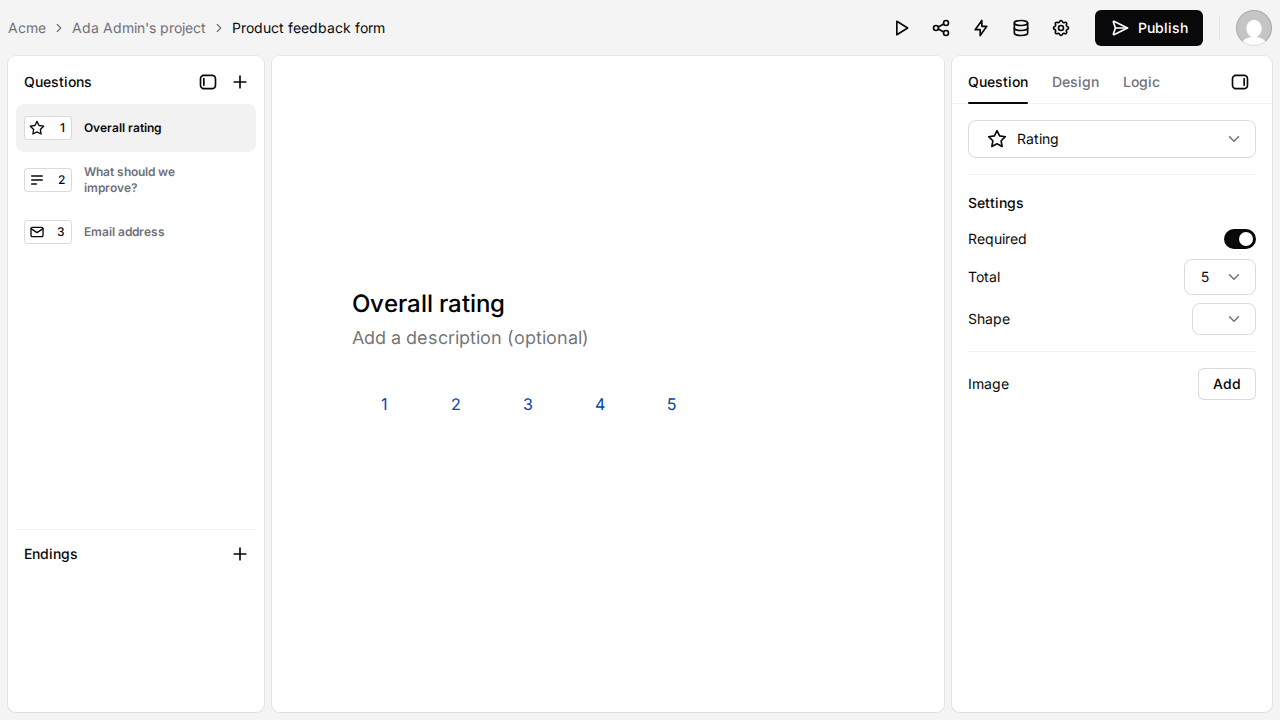
there's no OpenAI key to paste: we described a feedback form and got
three questions back.
The catch: HeyForm serves its login page and its forms on the same
address, so when you make forms public, the login is public too. The
install below closes sign-ups once your account exists. Give HeyForm its
own VM.
A form HeyForm generated through the exe.dev LLM gateway, on a test VM.Install HeyForm
On your computer (pick any free name):
```bash
ssh exe.dev new --name=my-heyform
ssh my-heyform.exe.xyz
```
On the VM, write the settings (secrets generated here, mode 600), the
Compose file, and start it. `VERIFY_USER_EMAIL=false` matters: HeyForm
wants an emailed code at sign-up unless you turn that off, and without
SMTP nobody gets the code. `TRUST_PROXY=1` records respondents' real
addresses rather than exe.dev's proxy.
```bash
sudo systemctl enable --now docker.service
mkdir -p ~/heyform/assets ~/heyform-backups && cd ~/heyform
if [ ! -f .env ]; then
(
umask 077
cat > .env < docker-compose.yml <<'EOF'
services:
heyform:
image: heyform/community-edition:v3.0.7
restart: always
env_file: .env
environment:
MONGO_URI: mongodb://mongo:27017/heyform
REDIS_HOST: keydb
REDIS_PORT: 6379
ports:
- "8000:9157"
volumes:
- ./assets:/app/static/upload
depends_on: [mongo, keydb]
mongo:
image: percona/percona-server-mongodb:8.0
restart: always
volumes:
- mongodb_data:/data/db
keydb:
image: eqalpha/keydb:x86_64_v6.3.3
restart: always
command: keydb-server --appendonly yes --protected-mode no
volumes:
- keydb:/data
volumes:
mongodb_data:
keydb:
EOF
docker compose up -d
until curl -fs -o /dev/null localhost:8000/; do sleep 3; done; echo HeyForm is up
```
While the VM is still private, open `https://my-heyform.exe.xyz/`, click
**Sign up**, make your account and a workspace. Then close sign-ups:
```bash
cd ~/heyform
sed -i 's/^APP_DISABLE_REGISTRATION=.*/APP_DISABLE_REGISTRATION=true/' .env
docker compose up -d
```
The sign-up page now sends people to the login, and HeyForm's API refuses
new accounts with `Registration is disabled`. On your computer, publish
the forms with `ssh exe.dev share set-public my-heyform`; form links look
like `https://my-heyform.exe.xyz/form/ok4czWRg`.
To use another model, change `OPENAI_GPT_MODEL` to one listed by
`curl -s https://llm.int.exe.xyz/v1/models | jq -r '.data[].id'`, or
delete the three `OPENAI_` lines to turn AI off.
Back up MongoDB, the uploads and the settings; on the VM:
```bash
cd ~/heyform
t=$(date -u +%Y%m%dT%H%M%SZ)
(umask 077
docker compose exec -T mongo mongodump --quiet --db heyform --archive --gzip > ~/heyform-backups/mongo-$t.archive.gz &&
tar -czf ~/heyform-backups/files-$t.tar.gz .env docker-compose.yml assets)
ls -l ~/heyform-backups
```
To restore one, use its timestamp:
```bash
cd ~/heyform
docker compose stop heyform
docker compose exec -T mongo mongorestore --quiet --drop --archive --gzip < ~/heyform-backups/mongo-20261122T043740Z.archive.gz
docker compose start heyform
```
To run backups nightly, schedule the backup lines as in
[Set up nightly backups](#set-up-nightly-backups). Upgrade by changing the
`heyform/community-edition` tag after reading its
[releases](https://github.com/heyform/heyform/releases), then
`docker compose pull && docker compose up -d`. Tested with HeyForm 3.0.7:
sign-up, AI form generation, publishing, a logged-out submission, and
backup and restore.
## The nuts and bolts
Happy clicking Deploy? You can stop here. These are the same setup steps
Shelley follows, plus the maintenance commands for later. Tested with
Formbricks 6.2.2 (Hub 0.14.3, SpiceDB 1.57.0, PostgreSQL 18 with
pgvector) on a new exe.dev VM: the install as written, a reboot, a restore
on the same VM and onto a second VM, and the update commands.
Install by hand
### Create the VM
On your computer (pick another name if `my-formbricks` is taken):
```bash
ssh exe.dev new --name=my-formbricks
ssh my-formbricks.exe.xyz
```
A new VM's 25 GB disk is enough to start; the images take about 5 GB.
All remaining installation commands run **on the VM**, as `exedev`. They
use `hostname`, so your VM can have any name.
### Get Docker ready
Enable Docker at boot, or exe.dev's on-demand Docker won't restart
Formbricks after a reboot:
```bash
sudo systemctl enable --now docker.service
systemctl is-enabled docker.service
```
Expect `enabled`.
### Download the Compose files
Formbricks' official Compose file needs three helper files from the same
release:
```bash
FB_VERSION=6.2.2
mkdir -p ~/formbricks/cube/schema && cd ~/formbricks
base=https://raw.githubusercontent.com/formbricks/formbricks/$FB_VERSION/docker
curl -fsSL -o docker-compose.yml $base/docker-compose.yml
curl -fsSL -o authzed-postgres-bootstrap.sh $base/authzed-postgres-bootstrap.sh
curl -fsSL -o cube/cube.js $base/cube/cube.js
curl -fsSL -o cube/schema/FeedbackRecords.js $base/cube/schema/FeedbackRecords.js
chmod 700 authzed-postgres-bootstrap.sh
grep -c 'ghcr.io/formbricks/formbricks:latest' docker-compose.yml
```
Expect `4`: four services use the app image with a `latest` tag, which
the next steps pin.
### Write the settings
This writes `~/formbricks/.env`, readable only by you, with every secret
generated here. The admin URL is the private port 3000; `PUBLIC_URL`, for
surveys, is the main address. `HUB_IMAGE_REF` comes from the release's
own Helm values, which name the Hub version it was tested with. It won't
overwrite an existing file.
```bash
cd ~/formbricks
FB_VERSION=6.2.2
HUB=$(curl -fsSL https://raw.githubusercontent.com/formbricks/formbricks/$FB_VERSION/charts/formbricks/values.yaml |
grep -A8 'repository: "ghcr.io/formbricks/hub"' | sed -n 's/^ *tag: "\(.*\)"/\1/p')
if [ ! -f .env ]; then
(
umask 077
PG=$(openssl rand -hex 32)
cat > .env < docker-compose.override.yml <<'EOF'
# Pin the Formbricks image; the upstream file says :latest.
x-formbricks-image: &formbricks-image ghcr.io/formbricks/formbricks:${FORMBRICKS_VERSION:?set in .env}
services:
formbricks-migrate:
image: *formbricks-image
formbricks:
image: *formbricks-image
authzed-initialize:
image: *formbricks-image
authzed-ops:
image: *formbricks-image
EOF
docker compose config --images | sort -u
```
Expect `ghcr.io/formbricks/formbricks:6.2.2`,
`ghcr.io/formbricks/hub:0.14.3`, `ghcr.io/formbricks/cube:1.8.8-3`,
`authzed/spicedb:v1.57.0`, `pgvector/pgvector:pg18` and a Valkey image
pinned by digest: no `latest`.
### Start Formbricks
The first start pulls about 5 GB and runs the database migrations; it
took about a minute and a half on our test VM:
```bash
cd ~/formbricks
docker compose up -d
until curl -fs localhost:3000/health; do sleep 5; done; echo
docker compose ps --format 'table {{.Service}}\t{{.Status}}'
```
Expect `{"status":"ok"}`, then `formbricks`, `hub`, `hub-worker`, `cube`,
`spicedb`, `postgres` and `redis` up. The one-shot setup services have
exited, which is right.
### Put nginx in front
exe.dev sends the main address to port 8000. nginx passes it to Formbricks
with the original `Host`, which matches `PUBLIC_URL`, so Formbricks serves
only the public routes there:
```bash
sudo tee /etc/nginx/sites-available/formbricks >/dev/null <<'EOF'
# exe.dev proxy -> :8000 (the port you make public) -> Formbricks :3000.
# The Host header is .exe.xyz, PUBLIC_URL's host, so Formbricks
# answers only surveys, the client API and static files here.
server {
listen 8000 default_server;
listen [::]:8000 default_server;
server_name _;
client_max_body_size 25m;
location / {
proxy_pass http://127.0.0.1:3000;
proxy_http_version 1.1;
proxy_set_header Host $http_host;
proxy_set_header X-Forwarded-Proto $http_x_forwarded_proto;
proxy_set_header X-Forwarded-Host $http_x_forwarded_host;
proxy_set_header X-Forwarded-For $http_x_forwarded_for;
proxy_read_timeout 300s;
}
}
EOF
sudo rm -f /etc/nginx/sites-enabled/default
sudo ln -sf /etc/nginx/sites-available/formbricks /etc/nginx/sites-enabled/formbricks
sudo nginx -t && sudo systemctl enable nginx && sudo systemctl reload-or-restart nginx
H=$(hostname).exe.xyz
for p in /health /auth/login /api/v1/management/me; do
echo "$p public $(curl -s -o /dev/null -w '%{http_code}' -H "Host: $H" localhost:8000$p)" \
"admin $(curl -s -o /dev/null -w '%{http_code}' -H "Host: $H:3000" localhost:3000$p)"
done
```
Expect `/health public 200 admin 200`, `/auth/login public 404 admin
307` (a redirect to first-time setup), and `/api/v1/management/me public
404 admin 401` (no API key yet).
### Set up nightly backups
The script dumps both databases while Formbricks runs, and saves `.env`
and the Compose files next to them:
```bash
cat > ~/formbricks/backup.sh <<'EOF'
#!/bin/bash
# Back up Formbricks: the formbricks and spicedb databases, plus .env
# (every secret) and the Compose files. Keeps two weeks.
set -euo pipefail
cd /home/exedev/formbricks
out=/home/exedev/formbricks-backups
mkdir -p "$out"
umask 077
t=$(date -u +%Y%m%dT%H%M%SZ)
docker compose exec -T postgres pg_dump -Fc -U postgres -d formbricks > "$out/formbricks-$t.dump"
docker compose exec -T postgres pg_dump -Fc -U postgres -d spicedb > "$out/spicedb-$t.dump"
tar -czf "$out/config-$t.tar.gz" .env docker-compose.yml docker-compose.override.yml \
authzed-postgres-bootstrap.sh cube backup.sh
find "$out" -name '*-20*' -mtime +13 -delete
ls -l "$out"/*-$t.*
EOF
chmod 700 ~/formbricks/backup.sh
```
Schedule it for 03:30 UTC (or so), then take a first backup:
```bash
sudo tee /etc/systemd/system/formbricks-backup.service >/dev/null <<'EOF'
[Unit]
Description=Back up Formbricks
[Service]
Type=oneshot
User=exedev
ExecStart=/home/exedev/formbricks/backup.sh
EOF
sudo tee /etc/systemd/system/formbricks-backup.timer >/dev/null <<'EOF'
[Unit]
Description=Back up Formbricks every night
[Timer]
OnCalendar=*-*-* 03:30:00
RandomizedDelaySec=30m
Persistent=true
[Install]
WantedBy=timers.target
EOF
sudo systemctl daemon-reload
sudo systemctl enable --now formbricks-backup.timer
sudo systemctl start formbricks-backup.service
systemctl list-timers formbricks-backup.timer
ls -l ~/formbricks-backups
```
Check that the timer has a next run and there are three files, readable
only by you: `formbricks-*.dump`, `spicedb-*.dump` and `config-*.tar.gz`.
For failures: `journalctl -u formbricks-backup`.
Installation done. Leave sharing to the owner; continue with
[Make your account](#make-your-account).
Back up and restore
On the VM, `~/formbricks/backup.sh` makes an extra backup at any time.
Copy backups off the VM as in [Keep responses safe](#keep-responses-safe).
### Restore
This replaces every survey, response and account with the backup's:
anything since is lost. Use your backup's timestamp below. On the VM:
```bash
cd ~/formbricks
./backup.sh # keep the current state, just in case
t=20261122T033012Z
docker compose stop
docker compose up -d --wait postgres
docker compose run --rm authzed-db-bootstrap
for db in formbricks spicedb; do
owner=postgres; [ $db = spicedb ] && owner=spicedb
docker compose exec -T postgres dropdb -U postgres --force $db &&
docker compose exec -T postgres createdb -U postgres -O $owner $db &&
docker compose exec -T postgres pg_restore -U postgres -d $db --exit-on-error \
< ~/formbricks-backups/$db-$t.dump || { echo "restore of $db failed"; break; }
done
docker compose run --rm --no-deps spicedb datastore repair transaction-ids
docker compose up -d
until curl -fs localhost:3000/health; do sleep 3; done; echo
```
Sign in and check your surveys and their responses. Two details matter.
The spicedb database must come back owned by `spicedb`, or SpiceDB fails
to start with `permission denied for table alembic_version`. And on a new
VM, SpiceDB can't see restored permissions (`no schema has been defined`)
until `datastore repair transaction-ids` catches PostgreSQL's transaction
counter up with the dump's; on the same VM it finds nothing to do.
On a **new** VM, do [Get Docker ready](#get-docker-ready), then copy the
backup's three files over; on your computer:
```bash
scp formbricks-backups/*-20261122T033012Z.* my-formbricks.exe.xyz:
```
On the VM, unpack the settings. If the VM's name changed, the `sed` points
the three URLs at the new name:
```bash
mkdir -p ~/formbricks ~/formbricks-backups && cd ~/formbricks
mv ~/*-20261122T033012Z.* ~/formbricks-backups/
tar -xzf ~/formbricks-backups/config-20261122T033012Z.tar.gz
sed -i "s|https://[a-z0-9-]*\.exe\.xyz|https://$(hostname).exe.xyz|" .env
```
Then run the restore commands above, without the `./backup.sh` line, and
do [Put nginx in front](#put-nginx-in-front) and
[Set up nightly backups](#set-up-nightly-backups). Survey links sent with
the old name won't follow; a [custom domain](#use-your-own-domain) avoids
that next time.
Update Formbricks
Formbricks wants upgrades one minor version at a time (6.2 to 6.3, never
skipping one), each to its latest patch, and publishes a page for each
version. Read the [release notes](https://github.com/formbricks/formbricks/releases)
and the [upgrade guide](https://formbricks.com/docs/self-hosting/advanced/upgrade)
first.
For a **patch** (6.2.2 to 6.2.3), on the VM: stop the writers, back up,
switch the files and versions, check, migrate and start. Replace `6.2.3`:
```bash
cd ~/formbricks
FB_VERSION=6.2.3
docker compose stop formbricks hub hub-worker
./backup.sh
base=https://raw.githubusercontent.com/formbricks/formbricks/$FB_VERSION
curl -fsSL -o docker-compose.yml $base/docker/docker-compose.yml
curl -fsSL -o authzed-postgres-bootstrap.sh $base/docker/authzed-postgres-bootstrap.sh
curl -fsSL -o cube/cube.js $base/docker/cube/cube.js
curl -fsSL -o cube/schema/FeedbackRecords.js $base/docker/cube/schema/FeedbackRecords.js
HUB=$(curl -fsSL $base/charts/formbricks/values.yaml |
grep -A8 'repository: "ghcr.io/formbricks/hub"' | sed -n 's/^ *tag: "\(.*\)"/\1/p')
sed -i -e "s/^FORMBRICKS_VERSION=.*/FORMBRICKS_VERSION=$FB_VERSION/" \
-e "s/^HUB_IMAGE_REF=.*/HUB_IMAGE_REF=:$HUB/" .env
docker compose config --quiet && docker compose pull
docker compose --profile authzed-ops run --rm --no-deps authzed-ops upgrade check
docker compose run --rm --no-deps formbricks-migrate &&
docker compose run --rm --no-deps hub-migrate &&
docker compose up -d
until curl -fs localhost:3000/health; do sleep 3; done; echo
docker compose images formbricks
```
The `upgrade check` must end with `"status":"ready"` and exit 0; if it
doesn't, stop there and read the version page. For a **minor** version,
there's an extra permission-preparation step between the backup and the
migrations: follow Formbricks'
[Docker Compose runbook](https://formbricks.com/docs/self-hosting/upgrade/docker)
with these same files. An older image doesn't undo migrations: to roll
back, [restore](#restore) the backup taken before the upgrade, with its
settings. We ran these commands end to end with 6.2.2 as the "new"
version; no newer release existed yet to test a real upgrade.
Something not working?
On the VM:
```bash
cd ~/formbricks
docker compose ps -a
docker compose logs --tail=100 formbricks
```
- **Survey links open exe.dev's login page:** the VM is private. Run
`ssh exe.dev share set-public my-formbricks`.
- **The login page is a 404:** you're on the public address. The admin is
`https://my-formbricks.exe.xyz:3000/`.
- **The editor's preview stays blank:** the public address is closed;
the preview loads from it. Make it public, or reload.
- **"File storage not set up, uploads will likely fail":** expected
without S3; see [File uploads](#file-uploads-optional).
- **A script gets 401:** that's exe.dev. Send the VM token in
`X-Exedev-Authorization: Bearer ...` and the Formbricks key in
`x-api-key`.
- **`spicedb-migrate` exited 1 with `permission denied`:** the spicedb
database lost its owner in a restore. Redo the [restore](#restore),
which recreates it owned by `spicedb`.
- **"Something went wrong" on every page after a restore, and `no schema
has been defined` in `docker compose logs spicedb`:** run
`docker compose run --rm --no-deps spicedb datastore repair transaction-ids`,
then `docker compose restart spicedb formbricks`.
- **The app logs `ETIMEDOUT` to postgres or redis:** recreate the
container with `docker compose up -d --force-recreate formbricks`.
- **Sign-in fails after renaming the VM:** the URLs in
`.env` still name the old VM. Fix them and run `docker compose up -d`.
- **Down after a reboot:** run `sudo systemctl enable --now docker.service`.
## Frequently asked questions
### Is Formbricks free to self-host?
The core is open source (AGPLv3) and free for commercial use, with unlimited surveys, responses and users, link and website surveys, logic, webhooks, the API and multi-language surveys. An Enterprise license adds teams and roles, contacts and segments, SSO, two-factor login, hiding the "Powered by Formbricks" badge, AI features and more than one workspace. You pay for your [exe.dev plan](https://exe.dev/pricing) either way.
### Why does Formbricks get two addresses?
Respondents need to reach your surveys, but nobody outside your team needs the admin. Formbricks can serve them on separate addresses, so the admin sits on a private port behind exe.dev login, and the public address answers only surveys, the client API and static files. Admin pages there return 404.
### How much does it need?
A new exe.dev VM (2 vCPUs, 8 GB of memory, 25 GB of disk) is plenty for a team. On our test VM the stack used about 1.5 GB of memory and 5 GB of disk for its images. Formbricks suggests 4 vCPUs, 8 GB and 50 GB once responses pile up; resize the VM when you get there.
### Can respondents upload files?
Not out of the box. Formbricks stores uploads in S3-compatible storage that respondents' browsers reach directly, so you need a bucket with a public HTTPS address. See [File uploads](#file-uploads-optional).
### Do I need an email server?
No. Without one, you copy invitation links by hand, and there are no password-reset emails or email follow-ups. Add [SMTP](#email-optional) when you want them.
### Can I use the exe.dev LLM gateway for its AI features?
Formbricks' AI features need an Enterprise license, so we couldn't test them. Formbricks does accept an OpenAI-compatible endpoint, so the gateway should work once licensed. HeyForm's AI form builder is free, and we tested it with the gateway: see [HeyForm](#heyform-a-simpler-form-builder).
### Formbricks or HeyForm?
Formbricks if you want product research: NPS and CSAT templates, surveys inside your website or app, a response API, and the admin kept off the internet. HeyForm if you want pretty, Typeform-style forms and a three-container install; its login page is public along with the forms.
## Related
- [Self-host n8n](https://exe-staging.dev/deploy/n8n-2.md): Connect your apps. Let the boring bits run themselves.
- [Self-host PostgreSQL](https://exe-staging.dev/deploy/postgres.md): Your own Postgres on a real disk, with backups you've actually restored.
- [Self-hosted S3 storage](https://exe-staging.dev/deploy/s3-storage.md): Your own S3 bucket on a real disk. RustFS, Garage or SeaweedFS, tested.
- [Self-host listmonk](https://exe-staging.dev/deploy/listmonk.md): Newsletters and mailing lists on your own VM. A Mailchimp alternative.
- [Self-host Chatwoot](https://exe-staging.dev/deploy/chatwoot.md): Website chat, email and API conversations in one inbox you own.
- [Self-host Appsmith](https://exe-staging.dev/deploy/appsmith.md): Admin panels and internal tools over your own databases, in an afternoon.